Friday, October 15, 2010

textiles

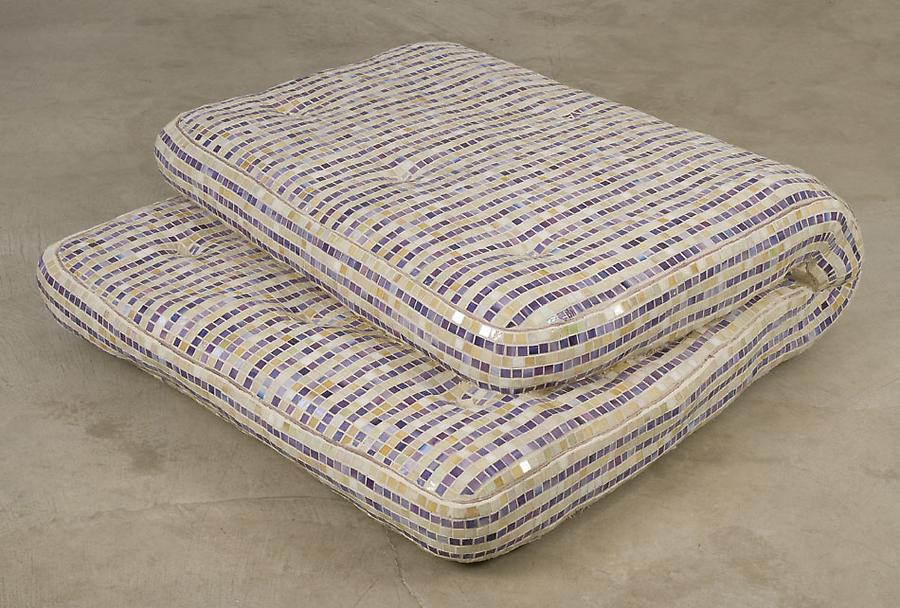
This show of fabric pieces by Louise Bourgeois sounds amazing and I really relate to her connection to textiles. "Made between 2002 and 2008 from clothes and other domestic effects collected by the artist over her decades long career, her fabric works are abstract in design yet intensely personal."

Here are two of my favorites:


This show made me think about a piece that I made while at Vermont Studio Center. Throughout the year that I spent in Vermont, I collected old handkerchiefs, dishtowels, pillows, lace, and bric-a-brac at the weekend yard (and barn!) sales. I didn't know what (if anything) I was going to make out of all of it ... I was just drawn to the tactility and beauty of the handmade objects, as well as the history behind them... the labor that goes into the embroidery.... the fact that many of them were so carefully made and then ended up in a pile of dusty linens in a barn.

I started dying the pieces different shades of green. This unified them and brought out the textures of the embroidery and lace...


I sewed the pieces together into one large banner-like rectangle and then photographed it by the river, on a very cold winter's day.


The greens looked so crisp and bright against the snow.

I'm not sure what else to say about it. It's a really sentimental piece and intricately connected to my year in Vermont.

feather-duster worms

From an artist's statement that I wrote in grad school:

"We use what is familiar to help us understand what is not. For example, in order to describe the plants and animals of the ocean, we combine descriptive words from our terrestrial world; porcelain crab, pelican's foot shell, moon snail, velvet swimming crab, feather-duster worm, acorn barnacle, and sea lettuce. In my artwork I use simple, everyday materials to describe a world that is impossibly beautiful and strange."

"The marine life collection, showing that underwater plants and animals are based on forms invented by man - fans, wigs, combs, brushes, etc." - J.J. Grandville, 1844.

Wednesday, October 13, 2010

current inspiration :: soft/hard objects

I'm looking at sculptures that appear to be soft or refer to fabric objects, but are made from hard materials:

Robert Gober (made with gypsum polymer and watercolor)

Robert Gober (bronze)

Ree Morton (made with celastic)

Shana Lutker

?

gravestones that I photographed

Tuesday, October 12, 2010

work in progress :: pillows

I'm currently working on a series of papier-mâché sculptures that are based on objects found in bedrooms. I've made 13 pillows so far and just started making a book. I'm interested in the process of re-creating familiar objects in my own way- I love things that are handmade and imperfect. There are also natural forms creeping into the sculptures and I imagine the finished body of work placed on a bed of sod.


mark manders at the hammer


I really loved this show. I wish I could have taken photographs in the museum because I can't find images of my favorite pieces. The descriptions that accompanied the sculptures were great: "If you are in a room with two books, a table, some clay, some pieces of wood, and a newspaper, this is one of the things you can make and place in front of you."

From the Hammer website:
"Through his sculptural practice, the artist seeks to bypass language, translating his thoughts and obsessions directly into three-dimensional objects—existing and self-made—and tableaux that incorporate figures, animals, household furniture, archeological fragments, everyday objects, and architectural components. Transformed by their proximity to one another, these mundane sculptural elements collectively evoke a mysterious world of daydreams and fairy tales."


His work reminds me a lot of Robert Gober's, one of my favorite artists. There are some obvious similarities such as the fact that they have both made their own newspapers.
Gober

Manders

Also, one of Mander's pieces at the Hammer was a slideshow of his sculptures in different environments. This reminded me of Gober's "Slides of a Changing Painting," an early piece that established his personal iconography... Both are interesting self-portraits.